• A Bill for the suppression of the practice was introduced into the British House of Commons in 1802, but was defeated by 13 votes, and it was not till the year 1835 that it was finally put down by Act of Parliament, called the Cruelty to Animals Act 1835
  • The Bulldog shoulders should be muscular, very heavy, widespread and slant outward, giving stability and great power. The elbows should be low and stand well out and loose from the body. The forelegs should be short, very stout, straight and muscular
  • Bulldogs and Terriers were developed in the British Isles. Both breeds became increasingly popular around the start of the 16th century when hunting was a major form of entertainment.
  • The Bullmastiff typically has a powerful build, symmetrical, showing great strength, sound and active. A well socialised animal will be high spirited, alert and faithful.
Showing posts with label American Dogs. Show all posts

Friday, July 6, 2012

Chinook Dog Strong Muzzle

The Chinook dog is a rare American breed of sled dog that was used in the first Byrd Antarctic Expedition in 1927. Created by Arthur Walden the Chinook dog was bred to be a working dog as well as a house pet. It is this ideal temperament that would save the breed from the grasp of extinction. The Chinook dog is a rare breed that was developed in North America during the early 20th century as a working sled dog. This breed was derived from a single dog called Chinook, owned by Arthur Walden in the 1920s.


The original Chinook dog was the result of crossing breeds, namely a Last revised: November, 2010 Husky with a Mastiff-like dog, but the offspring (including Chinook himself) did not closely resemble either of the parents. Later, most of Chinook’s offspring were similar to their father, and descendents were later bred with German Shepherd dogs, Eskimo dogs, and Belgian Sheepdogs, among other breeds. Chinook’s progeny ultimately created the Chinook breed that had the desired traits, such as being of good temperament and intelligence, strong, and fast.

Chinook dog

In later years, Chinook dogs were bred by Julia Lombard and Perry Green. Green bred Chinook dogs from the 1930s until 1963, and was the only breeder for many years. After his passing, the population of Chinook dogs dwindled, until there were only eleven breeding dogs left in 1981. Today, Chinook dogs are still rare with only around 700 in existence. Some mixes can also be registered as Chinook dogs if they are crossed with breeds that ar part of the Chinook breed ancestry (German Shepherd dogs, etc).


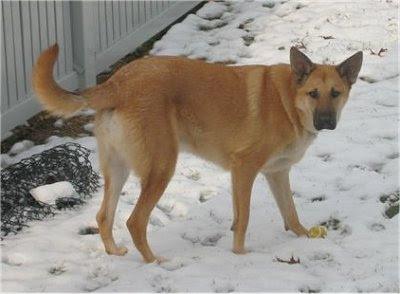
Traditionally, Chinook dogs and the breeds they were derived from were working dogs who liked to pull. While Chinook dogs are largely employed as family companions nowadays due to their affable temperament, some dogs are using their skill set to find a job. Chinook dogs are sometimes employed for search and rescue, obedience, agility, flyball, packing, herding, and “skijoring” (dog pulls a human who is on skis). The Chinook typically weighs between 55 and 90 pounds, with a height that ranges between 21 and 27 inches. It is a lean, muscular, and tawny-colored dog that may include darker markings around the muzzle and ears.
Chinook dog

A Chinook dog can have drop, prick, or “helicopter” ears. Helicopter ears are described as “similar to flying ears except that the outer edges of the ears fold inward and the inside edges of the ear stand out from the head, parallel to the ground .“ Chinooks should have a broad, rectangular shaped head with a strong muzzle. Its tail is saber shaped, and wellfurred. The Chinook has a double coat with a course outer layer with a soft undercoat that does not require a lot of grooming. While Chinook dogs have a double coat, they are said to vary in the amount of fur they shed. Some are said to be heavy shedders, while others shed twice per year. Other Chinook owners report very little shedding.


The overall physical appearance can vary in Chinook dogs; for example, some of these dogs more closely resemble a shepherd, while others may resemble a lab. The Chinook is agile and has great drive, which makes them great candidates for agility training.

Monday, April 30, 2012

Boxer Puppies Tips and Information

So you’ve made the decision to purchase a boxer but what should you need to know before you set out in search of your new Boxer puppy? The first thing you should do is research some reputable breeders on your area that have a reputation for breeding quality Boxers Dog. There are many ways to do this including contacting your local Boxer club, searching the internet and even contacting your local pet shop and asking them. An important consideration is the puppy’s bloodlines eg.Its mother and father. Make sure you check out the parents of your new puppy for unbecoming traits like aggression, hyperactive and extreme shyness. Experienced breeders will be able to give you a clear and honest background into the parents characteristics and usually have the parents on hand to view.

Boxer

Be sure to use extra caution if you are purchasing your boxer from a pet store, as they often get their supply from breeders of unknown reputation. Unfortunately some pet stores purchase their dogs from "puppy mills" as they are called and do not seem to put much emphasis on the quality, characteristics and health of Boxer puppies they offer for sale in their stores. In most cases reputable breeders and those that are members of such organizations such as the American Kennel Club, adhere to the accepted standards for Boxers in terms of uniformity in the breed, good health, temperament, size and color.

Be sure to ask your Boxer breeder for documentation detailing the pedigree of the Boxer puppy and registration papers. If the parents of the puppy are not available for viewing at the time, make sure to ask the breeder for photos of BOTH parents. You will find that most breeders are very cooperative and upfront and will usually provide these things without you having to ask for them. Professional breeders are also there to produce dog show champions or prospects so the quality is normally of a very high standard.

Even if you are not looking to raise a show champion Boxer Dog, known breeders can provide you with some "best buy" Boxer puppies because not all the Boxer puppies in a litter are show prospect/champion materials. But the full litter would have had benefited from the same proven bloodlines,nutrition and medical care. So you can choose from among the good looking brothers or sisters of a potential champion for a bargain price.

Buying a boxer as a puppy is only one option for you if you want a new pet, but what if you don’t want the challenges of owning a puppy? Well your other option is to adopt an older boxer from an animal shelter. These shelters receive up to 12 million homeless dogs and cats every year in the US alone, and about 25% of them are purebred. It’s also a nice option for those that don’t want to pay a premium price for a quality pup from a breeder as the shelter fee is usually a lot less, and not to mention you will be saving a life.

Boxer Dog

The definition of good stock or purebred must include beauty, and in a Boxer Dog good look means the coat is fawn and brindle, with the white markings or "flash" covering not more than one-third of the entire coat. Sometimes the distribution of the "flash" alone may make the difference between a show champion and just a pet Boxer. The all-white Boxer or "check" is unfortunately prone to blindness and deafness, and as a result the American Boxer Club members are not allowed to register, sell or use the "whites" for breeding purposes.

If you are deciding weather to choose from a make or female, there aren’t too many differences between their personalities. At times, the male is calmer, more tolerant of other dogs, willing to hold still for those hugs than the female. But at other times, the female can be so. Some female boxers have been know to get aggressive tendencies as they get older, but as boxers have such strong personalities each dog will certainly differ.

Boxer Health Problems

The main health problems faced by boxer dogs is that of the excretory system which are the organs responsible for regulating the chemical composition of body fluids and discharging waste. This problem concerns many boxer owners as in some instances, it can cause the dog to have future problems walking and running. The juvenile renal disease and the congenital rental disease can make the boxer dog very lame and in a great deal of pain. Proper prevention of breeding such dogs that are prone to this disease requires screening at an early age so it’s important to talk to your breeder about this prior to purchasing your Boxer dog.

As a boxer dog owner, you need to be aware of the treatments and dietary needs when caring for a Boxer that has such a disease. The common renal dysplasia is congenital and may show signs as early as one or two weeks after birth. X-rays will confirm any type of dysplasia in your puppy if you suspect it to have this problem. There are many speculations as to the cause of this disorder, all being linked to a gene. The autosomal dominate gene or the autosomal recessive gene contributes to the rental dysplasia in a Boxer.

Boxer

As a boxer owner you are responsible for proper care and medical treatment when necessary. Remember that you Boxer is essentially a member of your family and requires nurturing and proper diagnosis when attempting to treat a medical condition. Many veterinarians prescribe a low protein diet, which helps lower the production of uremic toxins, in turn making the dog feel better. Dr. Kenneth Bovee, DVM, researched a protein diet on the boxer and discusses that a low phosphorous level is a way to reduce the risk of kidney failure, whereas a higher level tends to speed up the affects of kidney failure in your beloved Boxer

To extend the life of your boxer it is essential that a well-balanced low protein diet that contains low levels of phosphorous is strictly enforced. If your Boxer has juvenile renal disease, a veterinarian will prescribe a diet of three to four feedings a day as a prevention measurement. This way of feeding your dog cuts down on the risk of vomiting after consuming the lower protein diet.

Most owners including you will find the egg and potato diet healthy for the Boxer dog because of the low protein and phosphorous levels provided. The diet will consist of the daily-recommended sodium levels as well as potassium. When making a meal for your Boxer, you will mix a large cooked egg, three cups of boiled potatoes with the skin, and recommended vitamins together for the perfect meal. The vitamins may include multiple mineral tablets, only half, two calcium tablets along with one teaspoon of chicken fat. This recommended meal fits the needs of a Boxer dog with renal failure.

Sunday, March 25, 2012

Black Mouth Cur Best Hunting Dog

Black Mouth Cur

Black Mouth Cur have been around for hundreds of years but they only made it to our shores in August 2011. Cousins Troy and Baden Crittle have imported four Black Mouth Cur three female and one male, from Southern Texas, USA. Black Mouth curs are a medium sized athletic dog, they are generally quite leggy and have a deep chest. The name Black Mouth Cur comes from the black mask that can extend from the jawline to just under the eyes, the body is a sandy or yellow colour.

Black Mouth Cur are a very versatile breed and the Crittle fella’s will be continuing this tradition. Troy’s dogs will be used for hunting pigs around NSW and Baden’s dogs will be used to work Brahman cattle in QLD. As a pigdog they are mainly finder bailers but most will hold the pig with another dog. “Although its early days, the dogs worked straight from quarantine” Troy said, “our imported dogs are only young and had been started on cattle in Texas but they bailed the first pigs that they saw” he added.


Baden Crittle is based on a property 100km west of Springsure in central Queensland. Baden said “the Black Mouth Curs took to working straight away and they will work the lead of a mob very naturally. What I like most about the Black Mouth Curs is their drive and keenness, they just love to work”. Baden went on to add “in the southern parts of the United States where the curs are bred and worked, its very hot and the curs ability to withstand heat is impressive”.

Black Mouth Cur

Black Mouth Curs are a very popular hunting breed in Texas. Some might say they are the most popular. They have been around for many years and there are several types and strains. Some curs such as the Ladner bloodline specialise in small game hunting but are also used for pig hunting. The Black Mouth Curs imported by the Crittle boys are based on the Weatherfords Ben bloodline. This bloodline originated in eastern and central Texas and goes back to one outstanding dog called Weatherfords Ben. Troy Crittle said “we thought long and hard about which bloodline to invest our time into and in the end we went with the Weatherfords Ben dogs”. Of the dogs imported into Australia one male was purchased from Randy Wright (who owned Weatherfords Ben) in Dryden, Texas and three females from David Thoms in Three Rivers, Texas.

Troy again “David Thoms and Randy Wright live and breathe dogs and we think we were successful in importing some great young dogs from them”. Baden Crittle was keen to point out that “Weatherfords Ben bloodline curs have a reputation for being tough but with brains to go with it, we are excited about their future in Australia working both rough cattle and big boars”. Both Troy and Baden Crittle plan to have Black Mouth Cur pups available to working homes in early 2012.

Black Mouth Cur

Saturday, March 24, 2012

Beagle History in America


Beagle beginning in Colonial times, Europeans emigrating to America brought dogs with them, some to serve as guards, some to pull carts and others to secure game for food. Some of these dogs were brought because of their innate ability to scent, to trail and to capture game. The first recorded mention of the Beagle was in Joseph Barrow Felt’s History of Ipswich, Essex, and Hamilton, published in 1834. The book was based in part upon early town records and, in the records for the year 1642, the Beagle is mentioned as having helped local hunters to keep wolves from the town.

Prior to the Civil War (1861–1865), hunters in the Southern states used small hunting hounds, including Beagles, to pursue fox and hare. During the war, almost all hunting ceased, but, after the war, interest again picked up. Wanting to improve the quality of their stock, some more affluent hunters imported Beagles from Europe. In the early 1870s, General Richard Rowett from Illinois became highly interested in Beagles. He imported dogs from England and from them bred what fanciers during those times thought were very good representatives of the breed. The Rowett Beagle were known for their consistency of type, evenness of markings and ability in the field.

Beagle

Another noted breeder of that period was Mr. Norman Elmore, who imported some influential dogs in the development of his Elmore line. Ringwood and Countess were two of these imports, with Ringwood being used at stud extensively and his offspring often taken to the Rowett strain. The two gentlemen, General Rowett and Mr. Elmore, worked together and the two strains produced what many thought were the best Beagles of the time. About 1880, Mr. Arnold of Rhode Island imported a pack of Beagles from the Royal Rock line in northern England. Approximately six years later, Mr. James L. Kernochan imported another pack from England, all of which had considerable influence on the quality of Beagles in America. From these times forward, the popularity of the Beagle rose steadily.

In 1885, a dog named Blunder was the first Beagle to be registered in the Stud Book of the American Kennel Club. The National Beagle Club was founded in 1888 and the club held the first field trial for the breed two years later in Hyannis, Massachusetts, with an entry of 18. It is believed that the first American standard for the breed was drawn up by General Rowett, Mr. Norman Elmore and a Dr. L. H. Twaddell. On December 21, 1901, Ch. Windholme’s Bangle, a five-yearold bitch owned by Mr. Harry T. Peters, became the breed’s first all-breed Best in Show winner. By 1917, the popularity of the Beagle as a show dog was evidenced by an entry of 75 at America’s premier show, the Westminster Kennel Club event, held in New York City. At this show, Beagles enjoyed great success, winning first in the Sporting Group (there was no Hound Group at that time), as well as Best Sporting Brace and Best Sporting Team in Show. It is interesting to note that it was at this event that Beagles were first shown as two varieties based on size: one class for Beagles 13 inches and under, and the other for Beagles over 13 inches but under 15 inches. The breed has been shown in America in these two separate varieties ever since.

Interest and enthusiasm for this clever little hunter have never waned in America. Today, the Beagle is one of the most popular all-around breeds, as a companion, an enthusiastic hunter and trailer and a highly competitive member of the Hound Group.

Thursday, March 8, 2012

American Staffordshire Terrier (Staffordshire Terrier)

American Staffordshire Terrier Fighting Dog


The American Staffordshire Terrier is not a new breed. Although it gained American Kennel Club registration and recognition in 1936, it has been developed since the early 1800’s as a result of crosses between the bulldogs of that time and game terriers. One of the early and very famous AKC registered Staffs was Pete the Pup, (real name Lucenay’s Peter), dog star of the original Our Gang comedies of the 1930’s. Although the early ancestors of this breed came from England, the development of the American Staffordshire Terrier is the story of a truly American breed. This type of dog was instrumental in the success of farmers and settlers who developed this country. They were used for general farm work, hunting wild pigs, bears, and other large game, guarding the homestead, and general companionship.


A number of the early ancestors were also developed for the “sport” of dog fighting. The extraordinary vitality of this breed is a direct result of breeding for successful fighting dogs. This now illegal activity is, unfortunately, more often cited as the early purpose of the dogs rather than the general farm work. Although ancestors of the American Staffordshire were fighting dogs, the selective breeding since the 1930’s has been away from the fighting heritage. The American Staffordshire Terrier of today is a companion and showdog, rather than a gladiator. Although more rarely used on the farm now, the talents that made him a good all purpose dog are still to be found in the breed.


General Impression: The American Staffordshire Terrier should give the impression of great strength for his size, a well puttogether dog, muscular, but agile and graceful, keenly alive to his surroundings. He should be stocky, not long-legged or racy in outline. His courage is proverbial.

Head: Medium length, deep through, broad skull, very pronounced cheek muscles, distinct stop; and ears are set high. Ears Cropped or uncropped, the latter preferred. Uncropped ears should be short and held half prick or rose. Full drop to be penalized.

Eyes : Dark and round, low down in skull and set far apart. No pink eyelids. Muzzle : Medium length, rounded on upper side to fall away abruptly below eyes. Jaws well defined. Underjaw to be strong and have biting power. Lips close and even, no looseness. Upper teeth to meet tightly outside lower teeth in front. Nose definitely black.


Neck: Heavy, slightly arched, tapering from shoulders to back of skull. No looseness of skin. Medium length. Shoulders : Strong and muscular with blades wide and sloping. Back : Fairly short. Slight sloping from withers to rump with gentle short slope at rump to base of tail. Loins slightly tucked.

Body: Well sprung ribs, deep in rear. All ribs close together. Forelegs set rather wide apart to permit of chest development. Chest deep and broad. Size: Height and weight should be in proportion. A height of about 18 to 19 inches at the shoulders for the male and 17 to 18 inches for the female is to be considered preferable. Tail: Short in comparison to size, low set, tapering to a fine point; not curled or held over back. Not docked.

Legs : the front legs should be straight, large or round bones, pastern upright. No resemblance of bend in front. Hindquarters well muscled, let down at hocks turning neither in nor out. Feet of moderate size, well-arched and compact. Gait must be springy but without roll or pace. Coat: Short, close, stiff to the touch and glossy. Color Any color, solid, parti, or patched is permissible, but all white, more than 80 per cent white, black and tan and liver not to be encouraged..

American Cocker Spaniel Hunter Dog


The American Cocker Spaniel evolved from a very old type of dog classified generally as Spaniels. The name “Spaniel” is mentioned in various literatures and pictured in woodcuts as early as 1328. The English literature and letters of the day always accepted that Spaniels originated in Spain. The partridge and quail hunters of the early 1800's wanted a smaller-sized dog who would simply find the game without disturbing it. Finally in 1892, the Kennel Club (England) recognized the “Cocker” as a classification and being a Spaniel that was less than 25 lb. (11-12 kg), and one that worked. The first Cocker was registered with the American Kennel Club in 1879. The Cockers at this time were long and low-bodied and were generally around 20 lb. (9-10 kg). In the early 1900’s, the American Cocker Spaniel Club, striving to maintain the Cocker in its sporting dog classification, made the standard call for a dog not less than 28 lb. (13 kg). It was during this time that the American Cocker Spaniel as we know it today really started to evolve into a separate and distinct breed of its own. 

The American Cocker Spaniel is the smallest member of the Sporting Group. He has a sturdy, compact body and a cleanly chiseled and refined head, with the over-all dog in complete balance and of ideal size. He stands well up at the shoulder on straight forelegs with a topline sloping slightly toward strong, muscular quarters. He is a dog capable of considerable speed, combined with great endurance. Above all he must be free and merry, sound, well balanced throughout, and in action show a keen inclination to work; equable in temperament with no suggestion of timidity.

The American Cocker Spaniel and Cocker Spaniel ideal height at the withers for an adult dog is 15 inches (38 cm), and for an adult bitch 14 inches (35.5 cm). Height may vary one-half inch (1 cm) above or below this ideal. A dog whose height exceeds 15-1/2 inches (39 cm), or a bitch whose height exceeds 14-1/2 inches (37 cm), shall be disqualified. An adult dog whose height is less than 14-1/2 inches (37cm), or an adult bitch whose height is less than 13-1/2 inches (34 cm) shall be penalized. Height is determined by a line perpendicular to the ground from the top of the shoulder blades, the dog standing naturally with its forelegs and the lower hind legs parallel to the line of measurement.


The body American Cocker Spaniel is short, compact, and firmly knit together, giving an impression of strength. The distance from the highest point of the shoulder blades to the ground is fifteen per cent or approximately 2 inches (5 cm) more than the length from this point to the set-on of the tail. Back is strong and sloping evenly and slightly downward from the shoulders to the set-on of the docked tail. Hips are wide and quarters well rounded and muscular. The chest is deep, its lowest point no higher than the elbows, its front sufficiently wide for adequate heart and lung space, yet not so wide as to interfere with the straightforward movement of the forelegs. Ribs are deep and well sprung. The American Cocker Spaniel never appears long and low.

American Cocker Spaniel Head : To attain a well-proportioned head, which must be in balance with the rest of the dog, it embodies the following: Skull rounded but not exaggerated with no tendency toward flatness; the eyebrows are clearly defined with a pronounced stop. The bony structure beneath the eyes is well chiseled with no prominence in the cheeks. Muzzle broad and deep, with square, even jaws. The upper lip is full and of sufficient depth to cover the lower jaw. To be in correct balance, the distance from the stop to the tip of the nose is one-half the distance from the stop up over the crown to the base of the skull. Nose of sufficient size to balance the muzzle and foreface, with well-developed nostrils typical of a sporting dog. It is black in colour in the blacks and black and tans. In other colours it may be brown, liver or black, the darker the better. The colour of the nose harmonizes with the colour of the eye rim. Mouth: the teeth are strong and sound, not too small, and meet in a scissors bite. Eyes: eyeballs are round and full and look directly forward. The shape of the eye rims gives a slightly almond-shaped appearance; the eye is not weak or goggled. The colour of the iris is dark brown and in general the darker the better. The expression is intelligent, alert, soft, and appealing. Ears lobular, long, of fine leather, well feathered, and placed no higher than a line to the lower part of the eye.


American Cocker Spaniel Coat : On the head, short and fine; on the body, medium length, with enough undercoating to give protection. The ears, chest, abdomen, and hind legs are well feathered, but not so excessively as to hide the American Cocker Spaniel’s true lines and movement or affect his appearance and function as a sporting dog. The texture is most important. The coat is silky, flat or slightly wavy, and of a texture which permits easy care. Excessive or curly or cottony textured coat is to be penalized.

American Cocker Spaniel Colour : Black Variety Solid colour black, to include black with tan points. The black should be jet; shadings of brown or liver in the sheen of the coat are not desirable. A small amount of white on the chest and /or throat is allowed, white in any other location shall disqualify. Any solid colour other than black and any such colour with tan points. The colour shall be of a uniform shade but lighter colouring of the feather is permissible. A small amount of white on the chest and/or throat is allowed; white in any other location shall disqualify.


Particolour Variety : Two or more definite, well-broken colours, one of which must be white, including those with tan points; it is preferable that the tan markings be located in the same pattern as for the tan points in the Black and ASCOB varieties. Roans are classified as particolours, and may be of any of the usual roaning patterns. Primary colour which is ninety per cent or more shall disqualify.

Tan Points
The colour of the tan may be from the lightest cream to the darkest red colour and should be restricted to ten per cent or less of the colour (of the specimen), tan markings in excess of that amount shall disqualify. In the case of tan points in the Black or ASCOB variety, the markings shall be located as follows:
(a) A clear tan spot over each eye
(b) On the side of the muzzle and on the cheeks
(c) On the undersides of the ears
(d) On all feet and/or legs
(e) Under the tail
(f) On the chest, optional--presence or absence not penalized. Tan markings which are not readily visible or which amount only to traces, shall be penalized. Tan on the muzzle which extends upward, over and joins shall also be penalized. The absence of tan markings in the Black or ASCOB variety in each of the specified locations in an otherwise tan-pointed dog shall disqualify.


The neck American Cocker Spaniel is sufficiently long to allow the nose to reach the ground easily, muscular and free from pendulous “throatiness”. It rises strongly from the shoulders and arches slightly as it tapers to join the head. The shoulders are well laid back, forming an angle with the upper arm of approximately 90 degrees which permits the dog to move his forelegs in an easy manner with considerable forward reach. Shoulders are clean-cut and sloping without protrusion and so set that the upper points of the withers are at an angle which permits a wide spring of rib.

American Hairless Terrier (AHT) Best Dog

American Hairless Terrier
American Hairless Terrier (AHT)
The American Hairless Terrier is a natural variation of the Rat Terrier. This completely hairless dog (some may have eyebrows and whiskers) is a lively, intelligent and friendly companion that is often the perfect answer for those with allergies who were never able to own a dog. The American Hairless Terrier generally gets along very well with children. One caution is with very young children. As a puppy especially, the American Hairless Terrier is small and can be accidentally injured by a wellmeaning but overly enthusiastic or careless child. Also any dog can growl or snap if pushed too far by any child. It is important that parent s take precautions to prevent accidental injuries to the puppy, teach the children proper handling and interaction with dogs, as well as supervise young children at all times with any dog, regardless of breed. 


The American Hairless Terrier is a companion dog with a average size of 10–16 pounds and lives an average of 12 - 15 years. They can live in apartment s, condos, or homes but due to their lack of hair, they are strictly an indoor dog. Grooming is relatively minimal since there is no fur. They require regular baths, nail trims, and keeping the ears clean. The American Hairless Terrier (AHT) is easily trained, MUST live indoors, can live in any climate when you use precautions against extreme weather conditions.

American Hairless Terrier Puppies

The American Hairless Terrier is unique from other hairless breeds, such as Chinese Crested or Xolo, as they do NOT have hair anywhere on the body (such as head, feet, or tail) and should not have any excess body hair. Dentition in the American Hairless Terrier is full and strong, and skin problems are rare.

Hairless Rat Terrier

For over three decades, a variety of Hairless Rat Terrier has been in the making. The beginnings of this variety traces to Willie and Edwin Scott of Louisiana, who encountered a hairless mutant in a litter of Rat Terriers. This pup, called Josephine, was bred to produce more hairless progeny, a feat that was finally accomplished after several litters. Trout Creek Kennel was established in 1981, after nine years of concerted effort by the Scotts. Unlike other hairless dogs such as the Chinese Crested and Mexican Hairless who have tufts of hair on their heads, feet and tail, the hairless Rat Terrier is completely bald, except for his whisker and eyebrows. All hairless breeds suffer from skin problems (due to the lack of coat and the exposure to the sun). Poor dentition is another characteristic of most hairless breeds, though the hairless Rat Terrier possesses a very strong compliment of teeth.

The American Hairless Terrier, the name reserved for these dogs, possesses a recessive gene for hairlessness, which differs from the genetic base for other such breeds that have a lethal dominant gene. The coated Rat Terrier, however, is still used in hairless breeding programs from time to time. Until a sufficient gene pool is established, the hairless Rat Terrier continues to be a “work in progress.” The UKC will recognize the American Hairless Terrier when this goal is finally reached. Depending on the association with which your Rat Terrier is registered, a hairless Rat Terrier may or may not be shown. The Rat Terrier Club of America does not permit such dogs to compete, while the UKC-affiliated American Rat Terrier Association does allow the hairless variety to participate. For more information on the hairless variety, contact the American Hairless Rat Terrier Club.

Probably the most famous Rat Terrier in American history was Skip, constant companion of President Theodore Roosevelt. He helped rid the White House of a rat infestation but was
most treasured for his ability to keep up with the President’s high energy level and passion for the hunt.


American Foxhound Tips and Information

American Foxhound
American Foxhound Review and Information
The  American Foxhound is a highly intelligent breed. They are very independent which can translate into stubbornness. Having patience and being persistent with this breed will bring much success when training to adapt to a family environment. It is important to make an informed pet selection and equally as important to make informed decisions throughout the life of your pet. We will take you through the process of bringing home your new family member and lead you all the way to cherishing your memories of the long life you share together. We will provide you with an outstanding number of tips and helpful advice including certified veterinary tips. This complimentary book is packed full of information to fulfill your dog parenting needs. Take a few moments to enjoy this information and you will spend many years enjoying a loving relationship with your American Foxhound.


The American Foxhound is an original hunting dog. They are bred to be hunters. With lots of attention and socializing, while they are young pups, these dogs can be trained to be watchdogs, obedient and agile. They do very well with children, as they have a mild mannered and gentle temperament. This is a very athletic breed and hard working. They are also very friendly and will get along with other household pets, just be sure to keep a watchful eye out when it comes to other non-dog pets in the family. They can be protective, especially around strangers. This is a lighter and taller dog than their counter-parts, the English Foxhound, and they are much quicker, as well. Their coats are short, which makes for minimal grooming.

They have long legs and shoulders. Their muzzles are long and they have small cat-like paws. Their ears are set low and hang. The American Foxhound prefers to run in packs. When choosing to become a pet-parent to this breed, it is best to choose a show dog, rather than one bred to hunt. The Foxhound requires a lot of attention and exercise; they can become obese if not given enough activity daily. This breed would not do well in an apartment setting, due to the fact that they need lots of exercise, rather a home with a big yard would be more suitable for them. It can be difficult to housebreak an adult Foxhound, so consideration needs to be taken in that choice. This breed does not like to be left alone or confined for long periods. Some health issues they may face would be hip dsyplasia, or deafness. A lot of attention, exercise, minimal grooming and veterinary attention will benefit you and your American Foxhound

American Foxhound Personality

When deciding to adopt, you should start your search within your own community. Adoption shelters and community rescue centers are a good place to start. You may also find such places as your local library, the newspaper or the internet, useful tools to aide in your adoption decision. Family and friends can be a great source of information, as well. When considering adoption of your pet, understand that not all pets are in rescue centers or shelters were abused, some have simply been left behind by families that may have experienced life changing events and could no longer care for their pets. The positive attribute to adoption, it is significantly less expensive than buying from a breeder. Ultimately the decision will be yours.


Choosing to purchase an American Foxhound from a breeder is a beneficial decision, as well. You are not only getting a 100% pure breed, in most cases, but you’re assured the dog will be healthy and well trained. When selecting a breeder, make sure they are reputable. Your breeder should be knowledgeable about the American Foxhound’s genetics and nutrition. Their structure and movements are important, too. A reputable breeder will make certain their pups have all their immunizations and inoculations at the times needed and that they are done under the advisement of their veterinarian. Be sure that your breeder gives individual attention to the socialization and raising of their pups, and have them give assurance that their pups are brought up in clean and healthy environments. 

American Foxhound

 It is also important that interaction with people and other pets be part of the breeding process. There are an array of screening methods one can use when choosing a breeder. Choose wisely, and be informed before you buy. Either option is viable based on your own knowledge, expectations, and personal conviction. The most important thing to remember when selecting your pet is to select the pet right for you. Pet ownership is a big responsibility. Select a pet that fits your lifestyle.


Choosing a dog can be a difficult decision because there are many different personalities and aesthetic qualities you may want to look for. When choosing your American Foxhound pup, be sure you are choosing carefully and informed about your breed.

American Akita History of Japanese Akita

American Akita

In the beginning, the history of the American Akita is similar to the history of Japanese Akitas. Since 1603, in the Akita region, Akita Matagis (medium-sized bearhunting dogs) were used as fighting dogs. From 1868, Akita Matagis were crossbred with Tosas and Mastiffs. Consequently, the size of Akitas increased, but characteristics associated with Spitz type were lost. In 1908 dog fighting was prohibited, but Akitas were nevertheless preserved and improved as a large Japanese breed. As a result, nine superior examples of Akitas were designated as « Natural Monuments » in 1931. During World War II (1939-1945), it was common to use dogs as a source of fur for military garments. The police ordered the capture and confiscation of all dogs other than German Shepherd Dogs used for military purposes. Some fanciers tried to circumvent the order by crossbreeding their dogs with German Shepherd Dogs. When World War II ended, Akitas had been drastically reduced in number and existed as three distinct types : 
1) Matagi Akitas 
2) Fighting Akitas
3) Shepherd Akitas. 


This created a very confusing situation in the breed. During the restoration process of the pure breed after the war, Kongo-go of the Dewa line enjoyed a temporary, but tremendous popularity. Many Akitas of the Dewa line, which exhibited characteristics of the Mastiff and German Shepherd influence, were brought back to the United States by members of the Military Forces. The Akitas from the Dewa line, intelligent and capable of adapting to different environments, fascinated breeders in the United States and the line was developed with increasing number of breeders and a great rise in popularity.

American Akita

The Akita Club of American was established in 1956 and the American Kennel Club (AKC) accepted the breed (inscription into the stud book and regular show status) in October 1972. However, at this time, the AKC and the JKC (Japan Kennel Club) did not have reciprocal agreements for recognizing each other’s pedigrees and therefore the door was closed for the introduction of the new bloodlines from Japan. Consequently, Akita in the United States became considerably different from those in Japan, the country of origin. They developed as a type unique in the United States, with characteristics and type unchanged since 1955. This is in sharp contrast with Akitas in Japan which were crossbred with Matagi Akitas for the purpose of restoring the original pure breed.

American Akita is Large-sized dog, sturdily built, well balanced, with much substance and heavy bone. The broad head, forming a blut triangle, with deep muzzle, relatively small eyes and erect ears carried forward almost in line with back of neck, is characteristic of the breed. Longer than high. Skin not too thin, neither too tight nor too loose. Height at withers : For males : 66 to 71 cm (26-28 inches), for bitches : 61 to 66 cm (24-26 inches).

American Akita Breeders

Thursday, February 23, 2012

Louisiana Catahoula Leopard Dog Best Marking

On July 9, 1979, the governor of Louisiana signed a bill making this breed the official State Dog of Louisiana. The Louisiana Catahoula Leopard Dog is a medium to medium-large, short-coated dog with a broad head, small-to-medium drop ears, and an undocked tail set on as a natural extension of the topline. The Louisiana Catahoula Leopard Dog is well muscled and powerful but not bulky, giving the impression of agility and endurance. The Catahoula Leopard Dog is a moderate breed and should not resemble either a sight hound or a bulldog in appearance. The body is just slightly longer than tall and the distance from the elbow to the ground should equal 50-60% of the dog's height from the withers to the ground. The Catahoula should be evaluated as a multi-purpose working dog, and exaggerations or faults should be penalized in proportion to how much they interfere with the dog's ability to work.


Because of the breed's name, many people assume that all Louisiana Catahoulas have the so-called "leopard" markings and blue eyes. In fact, the breed is noted for its many and unusual coat colors and patterns, as well as varied eye color. Louisiana Catahoula Leopard Dog temperament ranges from serious and business-like when working to clownish at home, with varying levels of energy. It is not uncommon for Catahoulas to be aloof with strangers, which often results in a lack of animation when showing and may cause some to draw away from judges when being examined.  Louisiana Catahoula Leopard Dog should never be excessively aggressive or shy. They can be independent, protective and territorial so they require firm guidance and a clear understanding of their place in the family unit. Catahoulas are affectionate, gentle and loyal family companions.

Sunday, February 12, 2012

Dogo Argentino Special Information


First of all, The Dogo Argentino has to be a dog that is completely in proportion, a little bit longer than tall. The males will look macho, and the female will look feminine. The head of the Dogo argentino is one of the most typical attributes of the breed. The skull and the face have the same length. The occiput must be masked by the powerful neck muscles. The occiput must be masked by the powerful neck muscles. They have to be dark or hazelnut colored. The expression must be intelligent.

The ears must be well on top of the head, either erect or semi erect, of triangle shape, and must
always be cropped in proportion to the headsize. Some country’s doesn’t allow the ear crop no-more. A nose has to be black pigmented (at least 75 %). 
 Dogo Argentino Weigh 40 to 50 kg, height 60 to 68 centimeters, but of course always in the right proportions. Good muscles in the thighs, with short nails, and closed toes, with no declaws and must have good angulations, always having in mind that they have the need for speed.

Dogo Argentino Character

1.  A magnificent hunter of wild boar and mountain lion.

2. The Dogo has an extremely strong hunting instinct.

3. The Dogo is also a people-oriented dog, who is extremely friendly and outgoing, unless given
reason to be otherwise.

4. His self-confidence makes him very trusting of humans with whom he is patient and
communicative.

5. While being incredibly obedient and willing to please, he is extremely sensitive to his handler
and cannot tolerate forceful training methods.

6. When properly socialized with children he is tolerant and gentle. He also should be socialized
with other animals at a young age for acceptance.

7. A Dogo Argentino gets easily bored, and when you don’t keep him occupied, or are not giving him the right amount of exercise they will find something to keep them occupied. With our family with 3 young kids and lots of toys, is this always a hard task as many Barbie’s, stuffed animals, pencils etc. have ended up in the garbage.


Health Concerns for the Dogo Argentino

The Dogo Argentino is a young and healthy breed, however like all breeds certain genetic disorders may be of concern.


Deafness:
@. Like most primarily white dogs, the Dogo Argentino can be born partially or completely deaf.
 

@. Inherited deafness in one or both ears is due to degeneration of sensory inner ear structures
within a few weeks of birth.
 

@. Deafness occurs in many breeds and is especially common in the Dalmatian.
 

@. There is a strong association of deafness with increased amounts of white in the coat and blue
eyes in breeds with merle and piebald coat coloring.
 

@. Deafness can occur in both ears, or just in the one ear.
 

@. When the dog is deaf in one ear, it’s really difficult to notice this.

Hip Dysplasia:
1. Canine Hip Dysplasia afflicts million of dogs each year and can result in debilitating orthopedic disease of the hip.

2. It is caused when the femoral head does not fit properly in the hip socket, causing instability of the joint.

3. Over time, his malformation can cause Degenerate Joint Disease which causes increased pain
and immobility.
 

Hip Dysplasia is the most common inherited orthopedic disease in large and giant dog breeds, and also occurs in several medium sized breeds. The disease is inherited with a polygenic mode of inheritance, meaning that multiple genes must be present for the disease to exhibit itself. It is not known however which genes are involved nor how many. Hip Dysplesia occurs bilaterally (in both legs). However, in approximately 7% of the cases, only one hip is affected.


Demodectic:
* Lots of white dogs, like a Dogo Argentino, Bullterrier, Mini Bull terrier, white Boxer, are
vulnerable for Demodectic, or Demodex, or Demodectic Mange.
 

* This can happen in a time that the puppy’s are teething, and also when a young female is
coming into her first heat.
 

* Physiological stress is a important factor determining the degree of severity of demodectic
mange.
 

* The younger the dog, the better the chance of cure.
 

* In many cases of adult-onset demodicosis, the disease is controlled by dips and baths but a cure is not always possible.


Demodectic is caused by a microscopic mite called Demodex canis. For some reason (teething, heat) in every case condition change in certain dogs will allow demodex mites to gain the “upper hand” and cause serious skin disease. Mites live inside hair follicles. If you don’t treat it, it will causes permanent bald spots on the skin. Mites are a normal resident of dog skin; it is only in some individual dogs that Mites cause problems. If you think your dog has demodectic, just ask your vet to take a skin scrape and put in under the microscope, this is the only way you can tell, if there are any mites. And if so start the treatment as soon as possible.

Friday, February 10, 2012

American Eskimo Dog Temperament and Characteristic

American Eskimo Dog
The American Eskimo Dog, a loving companion dog, presents a picture of strength and agility, alertness and beauty. It is a small to medium-size Nordic type dog, always white, or white with biscuit cream. The American Eskimo Dog is compactly built and well balanced, with good substance, and an alert smooth gait. The face is Nordic type with erect triangular shaped ears and distinctive black points (lips. nose. and eye rims). 

The white double coat consists of a short, dense undercoat, with a longer guard hair growing through it forming the outer coat, which is straight with no curl or wave. The coat is thicker and longer around the neck and chest forming a lionlike ruff, which is more noticeable on dogs than on bitches. The rump and hind legs down to the hocks are also covered with thicker, longer hair forming the characteristic breeches. The richly plumed tail is carried loosely on the back.


American Eskimo Dog Temperament
The American Eskimo Dog is intelligent, alert, and friendly, although slightly conservative. It is never overly shy nor aggressive, and such dogs are to be severely penalized in the show ring. At home it is an excellent watchdog, sounding a warning bark to announce the arrival of any stranger. It is protective of its home and family, although It does not threaten to bite or attack people. The American Eskimo Dog learns new tasks quickly and is eager to please.


American Eskimo Dog Size, Proportion, Substance  
Size: there are three separate size divisions of the American Eskimo Dog (all measurements are heights at withers)
 

Toy: 9 inches (23 cm) to and including 12 inches (30.5 cm).
Miniature: over 12 inches (30.5 cm) to and including 15 inches (38 cm).
Standard: over 15 inches (38 cm) to and including 19 inches (48 cm).
There is no preference for size within each division.
 

Proportion: length of back from point of shoulder to point of buttocks is slightly greater than height at withers, an approximate 1.1 to 1 ratio. Substance: the American Eskimo Dog is strong and compactly built with adequate bone.


American Eskimo Dog Coat & Colour  
Coat: the American Eskimo Dog has a stand-off, double coat consisting of a dense undercoat and a longer coat of guard hair growing through it to form the outer coat. It is straight with no curl or wave. There is a pronounced ruff around the neck which is more noticeable on dogs than bitches. Outer part of the ear should be well covered with short, smooth hair, with longer tufts of hair growing in front of ear openings. Hair on muzzle should be short and smooth. The backs of the front legs should be well feathered, as are the rear legs down to the hock. The tail is covered profusely with long hair. THERE IS TO BE NO TRIMMING OF THE WHISKERS OR BODY COAT AND SUCH TRIMMING WILL BE SEVERELY PENALIZED. The only permissible trimming is to neaten the feet and the backs of the rear pasterns.


Color: pure white is the preferred color, although white with biscuit cream is permissible. Presence of biscuit cream should not outweigh consideration of type, structure, or temperament. The skin of the American Eskimo Dog is pink -or gray.


American Eskimo Dog Head 
Expression is keen, intelligent, and alert. Eyes: are not fully round, but slightly oval. They should be set well apart, and not slanted, prominent or bulging. Tear stain, unless severe, is not to be faulted. Presence of tear stain should not outweigh consideration of type, structure, or temperament. Dark to medium brown is the preferred eye color. Eye rims are black to dark brown. Eyelashes are white.
 

Ears: should conform to head size and be triangular, slightly blunttipped, held erect, set on high yet well apart and blend softly with the head. Skull: is slightly crowned and softly wedge-shaped, with widest breadth between the ears. The stop is well defined, although not abrupt. The muzzle is broad, with length not exceeding the length of the skull although it may be slightly shorter. Nose pigment is black to dark brown. Lips are thin and tight, black to dark brown in color. The jaw should be strong with a full complement of close fitting teeth. The bite is scissors, or pincer.


American Eskimo Dog Neck
The neck is carried proudly erect, well set on medium in length and in a strong, graceful arch.


American Eskimo Dog Forequarters
Forequarters are well angulated. The shoulder is firmly set and has adequate muscle but is not overdeveloped. The shoulder blades are well laid back and slant 45° with the horizontal. At the point of shoulder the shoulder blade forms an approximate right angle with the upper arm. The legs are parallel and straight to the pasterns. The pasterns are strong and flexible with a slant of about 20°: Length of leg in proportion to the body. Dewclaws on the front legs may be removed at the owner's discretion: if present, they are not to be faulted. Feet are oval, compact, tightly knit and well padded with hair. Toes are well arched. Pads are black to dark brown, tough and deeply cushioned. Toenails are white.


American Eskimo Dog Body
The topline is level. The body of the American Eskimo Dog is strong and compact, but not cobby. The chest is deep and broad with wellsprung ribs. Depth of chest extends approximately to point of elbows. Slight tuck-up of belly just behind the ribs. The back is straight, broad, level, and muscular. The loin is strong and well-muscled. The American Eskimo Dog is neither too long nor too short coupled.


American Eskimo Dog Hindquarters
Hindquarters are well angulated. The lay of the pelvis is approximately 30° to the horizontal. The upper thighs are well developed. Stifles are well bent. Hock joints are well let down and firm. The rear pasterns are straight. Legs are parallel from the rear and turn neither in nor out. Feet are as described for the front legs. Dewclaws are not present on the hind legs.
 

The tail is set moderately high and reaches approximately to the point of hock when down. It is carried loosely on the back, although it may be dropped when at rest.
 

American Eskimo Dog Gait
The American Eskimo Dog shall trot, not pace. The gait is agile, bold, well balanced, and frictionless, with good forequarter reach and good hindquarter drive. As speed increases, the American Eskimo Dog will single track with the legs converging toward the center line of gravity while the back remains firm, strong, and level.


Faults
• amber eye color or pink eye rims
• pink nose pigment or pink lip pigment
 

Disqualification
• Any color other than white or biscuit cream
• Blue eyes
• Height: under 9 inches (28 cm) or over 19 inches (48 cm).


American Eskimo Dog Pictures and Wallpaper

Thursday, February 9, 2012

Doberman and Doberman Pinschers Tips and Info


One of the most emphatic recommendations I offer to novice dog people no matter what their breed is to spend time studying Doberman Pinschers in the ring. For one thing, the Doberman is a structurally “generic” breed. A Doberman should be so perfectly balanced that you are visually drawn to the dog as a whole. It is:

· Doberman Pinscher a square breed from the forechest to the buttocks.
· Doberman Pinscher a medium breed in every characteristic. No aspect should be overdone.
· Doberman Pinscher a totally balanced breed. All parts are in balance with the whole.

The other reason I encourage novices to study Dobermans in conformation competition is because structural soundness is fundamental to the Doberman’s breed type. There is no other way for a Doberman to excel in conformation. Since structural soundness is at the heart of our breed’s conformation, we cannot properly assess a Doberman by appearance only. We must feel for the tissue strength and muscle balance required to hold the structure in place, thus enabling the dog to move properly and efficiently.

As we go through our standard, the interrelationship between standard and structure becomes readily apparent:

Neck proudly carried: Without a proper shoulder assembly, a dog does not have the ability to carry the neck in a proud position.
 

Neck well arched : This requires proper ligamentation of the neck vertebrae. Therefore, a ewe neck, caused by poor ligamentation, is contrary to the standard. A Doberman dog or Doberman Pinschers with a ewe neck lacks the strength in its neck to be capable of holding onto a person. Anytime a dog is lacking a component that prevents it from accomplishing the purpose for which it was bred, it is lacking in breed type.


Nape of neck widening gradually toward body : This requirement prohibits a stovepipe neck, which is caused by poor musculature and again prevents the dog from doing the job for which it was bred.

Withers pronounced and forming the highest point of the body : The withers are the area between the set on of the neck to the back. It consists of extremely thick, strong muscles which also help protect the shoulder blades. The withers should be pronounced but shoulder blades should never be the highest point of the dog. The spine should always be higher. High shoulder blades can loosen the shoulders and cause an upanddown motion, like that seen in the shoulders of a cat. (This highset, loose shoulder makes for a leaping motion instead of a strong trotting action.)

Back short, firm : The “short” aspect increases strength in the back and makes it less susceptible to injury. The “firm” aspect is created by a good front assembly. A soft or dipping topline is an indication of a structural weakness or imbalance in the front assembly. Along the same lines, a roach or rise in the topline is almost always caused by a structural weakness of the rear assembly.

Chest broad : A broad chest is the result of both proper ribs and a proper front assembly placement. A front assembly placed too far forward will not allow the appearance of a broad chest.

Forechest well defined : Because nothing on the Doberman should be exaggerated, a pigeonbreasted dog is as incorrect as one with an overdone forechest.

Ribs well sprung : This is crucial for lung and heart capacity. If lung and heart capacity is restricted by slabsided ribs, the dog’s stamina and endurance can be impaired.

Brisket reaching deep to the elbow : This is also necessary for heart and lung capacity plus proper attachment of the upper arm and is also necessary for balance.

Belly well tucked up, extending in a curved line from the brisket : This excludes a herring gut, which is created when the length of the ribs ends too abruptly. The ribs behind the legs should all be approximately the same length to the ninth rib, and then gradually curve to the tuckup. If the depth stops too abruptly, there is a much straighter or more extreme line to the loin. The more extreme the underline, the more restricted the heart and lung capacity. A dog with a herring gut will lack stamina and endurance.


Loins wide and muscled : There is no support for the topline past the attachment of the last rib, so a short (within reason) loin makes for a stronger back, which is less susceptible to injury. The muscling of the loin is crucial for proper flexibility. Shoulder Blade sloping forward and downward at a 45degree angle to the ground meets the upper arm at an angle of 90 degrees : A dog cannot reach any farther forward that what the angle of the shoulder allows. Also, its reach cannot extend beyond the end of its nose. So the shorter the neck, the shorter the dog’s reach, no matter what its shoulder angle is.

The straighter the upper arm the farther forward the front legs are positioned, which affects both the static (standing) and kinetic (moving) balance. The space between the shoulder blades must always fit the dog. If the blades are too close together, front motion is affected and the dog’s ability to lower it head is inhibited. If the blades are too far apart, the front legs are set farther apart and roughen the shoulder lay into the body; both of these consequences prohibit smooth, efficient front assembly motion. Straight or wide shoulder blades are the main cause of wrinkles over the shoulders.

 Pasterns firm and almost perpendicular to the ground : The pasterns are one of the areas most susceptible to injury. If they are too straight, they lose the ability to absorb shock. If they are too angled, they lose the strength necessary to provide support.

The angulation of the hindquarters balances that of the forequarters. . . . Upper Shanks at right angles to the hip bones, are long, wide, and well muscled on both sides of the thigh : This is crucial as this is the ham. It must have the same amount of meat on both sides of the bone. If muscles are imbalanced, there is no balance. This imbalance of the muscle mass is what causes a dog to be either cow hocked (where it is more heavily muscled on the inside of the legs) or barrel, spread or open hocked (where there is more muscle on the outside of the legs). A lack of muscle mass on either the inside or outside of the rear legs destroys stability. The dog will have a limited ability to make fast or tight turns.

Length of the shoulder blade and upper arm are equal : If the shoulder is relatively the same length as the upper arm, front assembly muscles can work in unison. If the bones are out of proportion, it causes the muscle that is over the longer bone to be stretched farther than the other muscles, which in turn affects its strength. The standard calls for balanced, smooth motion, which is unattainable if the muscles themselves are out of balance. The upper arm provides the pendulum motion of the front leg and contributes to the center of balance in motion. A short upper arm is incapable of bringing the front far enough under the body to create speed and balance. Therefore, it impedes the dog’s stride in a gallop. In a trot, it creates excess motion, usually in the pastern area, or prevents the dog from moving along a single line of support.

Height from elbow to withers approximately equals height from ground to elbow : This 50:50 ratio helps to create necessary overall balance. If the dog has more leg than depth of body, either from a chest that is too shallow or from legs that are too long, the dog becomes topheavy, which means it must slow down to make quick turns. How efficient can a Doberman be that is unable to make quick turns at top speed?

Elbows lie close to the brisket : Always check for looseness in the elbows by rocking the dog to the side. Poor ligamentation usually causes the elbows to pop or move outward when in motion, which in turn can cause the dog to toe in its front feet. Loose elbows increase the risk of structural damage when landing from jumps; the impacts stretch the tissue. As the tissue wears out, there is greater wear on the bone, which increases the possibility of arthritis as the dog ages.

Upper and lower shanks are of equal length : The length from the point of the buttocks to the kneecap should be the same as the length from the kneecap to the point of the hock. Just as with the front assembly, equal lengths allow the muscles to work properly. If the lower thigh is longer than the upper thigh, the rear assembly is weakened.

Hock to heel is perpendicular to the ground : The stability of the hock is the cornerstone of the rear. There should never be any motion in the joint not in, out or forward.

For example, a square Doberman Pinschers (as required by the standard) will have a proper side gait, if it is properly made. A longer dog may appear to have a proper side gait without having as good of structure. Therefore the standard of a square dog demands better structure. By the same token, the straighter the angles, front and rear, the easier it is to create clean motion coming and going, but straight angles restrict movement as seen in the side gait. Also for a Doberman Pinschers to be clean coming and going it must have a proper prosternum. There can only be as much muscle as surface to attach it to. The more shallow the prosternum, the less muscle there is attaching the upper arm to the rib cage. This is one of the major reasons for sloppy front action.

Mobile