• A Bill for the suppression of the practice was introduced into the British House of Commons in 1802, but was defeated by 13 votes, and it was not till the year 1835 that it was finally put down by Act of Parliament, called the Cruelty to Animals Act 1835
  • The Bulldog shoulders should be muscular, very heavy, widespread and slant outward, giving stability and great power. The elbows should be low and stand well out and loose from the body. The forelegs should be short, very stout, straight and muscular
  • Bulldogs and Terriers were developed in the British Isles. Both breeds became increasingly popular around the start of the 16th century when hunting was a major form of entertainment.
  • The Bullmastiff typically has a powerful build, symmetrical, showing great strength, sound and active. A well socialised animal will be high spirited, alert and faithful.

Friday, July 6, 2012

Chinook Dog Strong Muzzle

The Chinook dog is a rare American breed of sled dog that was used in the first Byrd Antarctic Expedition in 1927. Created by Arthur Walden the Chinook dog was bred to be a working dog as well as a house pet. It is this ideal temperament that would save the breed from the grasp of extinction. The Chinook dog is a rare breed that was developed in North America during the early 20th century as a working sled dog. This breed was derived from a single dog called Chinook, owned by Arthur Walden in the 1920s.


The original Chinook dog was the result of crossing breeds, namely a Last revised: November, 2010 Husky with a Mastiff-like dog, but the offspring (including Chinook himself) did not closely resemble either of the parents. Later, most of Chinook’s offspring were similar to their father, and descendents were later bred with German Shepherd dogs, Eskimo dogs, and Belgian Sheepdogs, among other breeds. Chinook’s progeny ultimately created the Chinook breed that had the desired traits, such as being of good temperament and intelligence, strong, and fast.

Chinook dog

In later years, Chinook dogs were bred by Julia Lombard and Perry Green. Green bred Chinook dogs from the 1930s until 1963, and was the only breeder for many years. After his passing, the population of Chinook dogs dwindled, until there were only eleven breeding dogs left in 1981. Today, Chinook dogs are still rare with only around 700 in existence. Some mixes can also be registered as Chinook dogs if they are crossed with breeds that ar part of the Chinook breed ancestry (German Shepherd dogs, etc).


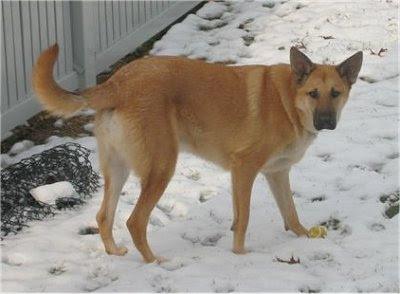
Traditionally, Chinook dogs and the breeds they were derived from were working dogs who liked to pull. While Chinook dogs are largely employed as family companions nowadays due to their affable temperament, some dogs are using their skill set to find a job. Chinook dogs are sometimes employed for search and rescue, obedience, agility, flyball, packing, herding, and “skijoring” (dog pulls a human who is on skis). The Chinook typically weighs between 55 and 90 pounds, with a height that ranges between 21 and 27 inches. It is a lean, muscular, and tawny-colored dog that may include darker markings around the muzzle and ears.
Chinook dog

A Chinook dog can have drop, prick, or “helicopter” ears. Helicopter ears are described as “similar to flying ears except that the outer edges of the ears fold inward and the inside edges of the ear stand out from the head, parallel to the ground .“ Chinooks should have a broad, rectangular shaped head with a strong muzzle. Its tail is saber shaped, and wellfurred. The Chinook has a double coat with a course outer layer with a soft undercoat that does not require a lot of grooming. While Chinook dogs have a double coat, they are said to vary in the amount of fur they shed. Some are said to be heavy shedders, while others shed twice per year. Other Chinook owners report very little shedding.


The overall physical appearance can vary in Chinook dogs; for example, some of these dogs more closely resemble a shepherd, while others may resemble a lab. The Chinook is agile and has great drive, which makes them great candidates for agility training.

Chinese Imperial Dog Info and Pictures

Is very different than a Shih Tzu and a Imperial Shih Tzu Chinese Imperial Dog is registerd as a Chinese Imperial Dog ! Not as a Shih Tzu like the Imperial. A first generation Chinese Imperial dog has been certified by weight and measurements stated by the parent club of the CID To be a second generation CID both parents of the dog has to be a registerd Chinese Imperial by the Chinese Imperial Dog Registry of America, Than those the pup reach 14 months they must also be certified by weight and length to be register by the Chinese Imperial Dog Registry of America. All 3rd generation Cids must also be verified at 14 months
The Cid is becoming accepted by the RARE breed registry soon. In years to come when the CID breeders have 1000 3rd generation Cids will become a new breed reconized by the American Kennel Club Foundation Stock Service. Than AKC will make the Chinese Imperial Dog is own breed and can be in AKC dog shows and we will compete with the Shih Tzu.

Chinese Imperial Dog


Article By http://www.imperialshihtzu.com

Chinese Crested (Dog) Discussion

Chinese crested
Experimental breeding with hairless dogs has been limited in scope, probably because of the expense. Scanning the literature5'7 yielded the following data: matings of hairless to normal coated dogs gave 12 hairless and 8 normal pups; matings of hairless to hairless gave 18 hairless to 9 normal pups; while normal to normal, bred from hairless, gave 11 normal pups. The present observations have greatly augmented the above data. The origin of the Chinese crested is obscure and it is impossible to ascertain if the same hypotrichotic gene is involved. However, the similarity of phenotype and mode of inheritance could imply an identity of kind if not absolute identity.


The Chinese crested dog is naked except for coarse hairs on the face and dome of the head, in the lower part of the legs and tail. The covering on the extremities appears to consist of guard hairs only; the underfur or down hairs are absent. A line of coarse hairs often occurs along the midline of the back but this is held to be a fault in the show ring and breeders are selecting against it. The skin may be either soft and pliable or be thickened by layers of cornified cells. To the human hand, the skin feels distinctly warm. The assortment data are consistent with autosomal dominant monogenic inheritance of the hypotrichosis. Accordingly, the gene is symbolized8 as Hr. Although the observed ratio of hairless to normal pups from matings between Chinese crested individuals does not differ significantly from a 3:1 ratio, the agreement is poor and just fails to be significant. 

The ratio is much closer to the 2:1 ratio to be expected upon the assumption that the homozygous hairless is lethal. One of the reasons for assuming that the homozygous is lethal is that breeders have failed over the years to eliminate the normal haired segregants. Another is the significant difference of mean litter sizes for the mating of Chinese crested to powderpuff versus mating of Chinese crested inter se. The lethality of HrHr probably occurs prenatally since Chinese crested breeders do not seem to be troubled with extraordinary perinatal anomalies, still-births, or death of young pups.

Chinese crested

A primary difference between other hairless dogs and the Chinese crested is the greater amount of hair on the extremities of the latter. A feature of the breed is a well developed crown of hair (the "crest"). To enhance the quantity of hair, the gene for long hair (/) has been incorporated into the genotype. The presence of the long haired gene is revealed by the normal •haired segregants, all of which have long hair. Hence, the name of powderpuff for those individuals.


The hair of the Chinese crested may be colored (black, yellow), white with a variable colored spot or completely white, the last two forms predominating. The body skin may be bluish pigmented or mottled with pink areas. The mottled effect is due to either piebald (sP) or extreme-white alleles of the white spotting locus6'8. This is revealed by the white spotted phenotypes of the powderpuff segregants. The body skin may be extensively pigmented even when the hair is completely white. This is consistent with the view that the melanoblasts may populate the dermal layers of the skin without entering the hair follicles if they arrived after the follicles have sufficiently differentiated to become impervious to melanoblasts. It is probable that white spotting in the dog is due to retarded melanoblast migration due either to 1) deficiency of primary melanoblast sites in the neural crest, or 2) to slow migration of the embryonic melanoblasts.

Chinese crested Puppy

The Chinese crested individual is generally robust and healthy. The only anomaly mentioned by several breeders involved the dentition in that a number of dogs had forward pointing canine teeth. The powderpuff segregants are stated to possess normal dentition.

Chinese Crested Dog Powerful

The Chinese Crested Dog Is devoid of hair except for the crown of the head, lower part of the limbs and tail. The breed is produced by a dominant gene for hypotrlchosls (Hr) In combination with the gene for long hair (/). The homozygote (Hr) Is a prenatal lethal, hence the Chinese crested dog Is an obligate heterozygote. The long haired segregants, ++II, are known as powderpuffs. HAIRLESS DOGS arc of considerable antiquity, being described as early as 1600 and subsequently by several distinguished zoologists. Their accounts indicate that the hairless dog >. has been reported from many subtropical regions of the world where the lack of an insulating pelage is not a disadvantage. Their unique appearance invariably excites interest and they have been given such exotic names as the African, Ceylon, Chinese, Egyptian, and Turkish hairless dog1"3. It is doubtful if many of these merit designation as breeds although the Mexican hairless and the Xoloitzcuintli are often referred to in these terms.

Chinese Crested Dog

The Chinese crested dog has been  since the latter part of the 19th century10, but it is only comparatively recently that it has gained significant popularity among breeders in the United States and Britain. The dog is basically similar to the other hairless dogs but differs in the greater amount of hair shown on the extremities, viz., crown of the head, feet, and tail. Previous accounts of breeding hairless dogs have indicated that the hairlessness is due to a dominant gene that is lethal when homozyigous. Consequently, normal coated offspring are to be expected to occur in breeding the Chinese crested if the hairlessness is due to a similar gene. This is the situation and the normal coated dogs are known as powderpuffs.

The growing popularity of the Chinese crested Dog has meant that reasonable numbers are being bred instead of the odd few litters had the dog remained a rarity. An appeal was made by' personal contact, postal communications, and via the medium of the canine press for breeders to furnish information on their breeding. Details were requested for the parents and for each pup in the litter. Information was obtained for 83 litters comprising 330 pups. These were divided into 30 litters of 143 pups for matings of Chinese crested to powderpuff, and 53 litters of 187 pups from Chinese crested to Chinese crested. The distribution of litters was roughly normal but slightly skewed toward smaller litters for both matings. For the first, the range was from two to eight pups per litter, a mode at five pups and a mean of 4.77 ± 0.30 pups. For the second, the range was from one to seven pups, a mode at four pups and a mean of 3.52 ± 0.21 pups. The difference between means of 1.24 ± 0.34 is highly significant.

Chinese Crested Dog

The progeny from both matings consisted of both Chinese crested and powderpuff pups. From matings between Chinese crested and powderpuff, there were 79 Chinese crested and 64 powderpuff. The deviation from a monogenic 1:1 ratio is nonsignificant (x2 = 1.57 for 1 df). From matings between Chinese cresteds, there were 129 Chinese crested and 58 powderpuffs. The deviation from a monogenic 3:1 ratio is subsignificant (x2 = 3.61 for 1 df). However, the data are a better fit to a 2:1 ratio upon the assumption that the homozygous hairless is lethal (x2 = 0.46 for 1 df).

Sunday, July 1, 2012

CHILEAN FOX TERRIER DOG

Chilean Fox Terrier History. There is evidence of their presence in our country since Colonial times, when European immigrants settled in South America, bringing Fox Terriers Smooth and Bodeguero Andaluz dogs with them. These dogs mated with local dogs with undefined breed, giving birth to the Chilean Terrier. During the XVIII and XIX centuries the breed was developed in the farms of the central and southern side of Chile, easily adapting to a rustic life, often situated in stables. At the end of the XIX century, and the beginning of the Industrial Revolution, many countrymen migrated to the cities, taking their families and Chilean Terriers with them. This breed quickly adapted to the “urban” life, being used in the new industries and human settlements (cités) to exterminate rats.

This way, the Chilean Terriers continued to be present in middle class homes of our country, becoming even more popular through the local comic book “Condorito” and his ever-faithful dog “Washington”. In 2004 a group of breeders and fans decided to work for recognition and promotion of the Chilean Terrier within the “Asociación Gremial de Criadores y Expositores de Perros de Chile”. In 2007 the National Chilean Terrier Club was formed, planning the breeding and establishing the standard type. Currently its presence crosses the whole Chilean territory, as it has the virtue of adapting to a variety of climates and ways of life, being still used in rural areas as a rat hunter and in the city, as an excellent companion dog, friendly and vivacious.

Chilean Fox Terrier

Chilean Fox Terrier General Appearance: Compact and, medium sized dog, well balanced, elegant and firm but not heavy. Short and tight hair, where marks and color symmetry stand out. Short tail, often born without it. Significant Proportions: The height of the withers represent a 90% of the length of the dog. It is desirable in the case of males a nearly square body and a little longer body is allowed in bitches due to the reproductive function.
Temperament: Brave, gentle, lively, alert and energetic.

Head: Its shape is triangular if viewed from the top, broad at its base and thinning towards the tip of the muzzle. Looking at its side face, a slight convexity to the occipital bone is observed.
1. Skull: Rounded with almost flat forehead, the stop not very pronounced.
2. Facial Region:

Nose : with wide nostrills, always black in tricolors and red dogs;brown in the case of the chocolates. Muzzle: strong and triangular viewed from the top. Lips: Clean and tight, Cheeks: Thin and clean. Bite: a complete scissor bite with well developed teeth; level bites are accepted but undesirable as well as the absence of any tooth or jaw deformation. Eyes: small, moderate separation, almond shaped, dark, a bit lighter version is accepted in chocolate type. Bright eyes are undesirable. Ears: small, set high, moderate separation, triangular shaped, half-upright and pointed tips, laying down in to the corner of the eye. Neck: Slightly curved, of medium length , thicker in the case of males.

Chilean Fox Terrier

Chilean Fox Terrier Body: Compact and well structured, almost square shaped and shorter in case of males. Strong but not heavy, with clearly defined curved lines. Withers: high and well defined. Topline: firm and straight, going slightly downwards from the withers to the croup. Back: short and well muscled. Loin: short, firm and strongly muscled. Croup: wide, well developed and muscled, with evident inclination. Underline and belly: Slightly curved.

Chilean Fox Terrier Tail: Low set, moderately broad at its base. An important number of dogs are born anuran. . Between two dogs of similar quality, the naturally anuran one should be selected. In its country of origin and, due to its use as rat exterminator, the tail is docked at the second vertebra. The presentation of dogs with complete tails is not desirable. When they are naturally born with tail and it is not cut off, the tail should not reach the hocks and have a high position without curving over the back.

Chilean Fox Terrier Size and Weight: Size: male between 32 and 38 cm., ideal 35 cm; female, between 28 and 35 cm, ideal 32 cm. A variation of 1 cm. below these measures is allowed as long as the dog keeps the right proportions, which will allow him to develop its function in an optimal way. Weight: Male: between 5 and 8 kilos. Ideal weight: 6,5 kilos ; Female: between 4 and 7 kilos. Ideal weight: 5,5 kilos. FAULTS: Any deviation from the criteria mentioned previously must be considered a fault and its sevirity should be in exact proportion to the degree of deviation to the standard.

Chihuahua Dog and Chihuahua Puppies

One owner says “I almost lost my entire wardrobe to my Chihuahua puppy. I can’t believe how much he can chew and destroy in the course of an afternoon.” People do not usually associate destruction with the lovable and pint-size Chihuahua; however, charming as this breed is, it is also a natural born "chewer". The bad news: you won't be able to break this natural instinct. The good news:
 

with plenty of exercise and a little training, you won't have to. As puppies mature, they tend to grow out of this habit. But, even mature dogs can slip back into the pattern of chewing on your favorite pair of sneakers. That is why it is so important to give your dog basic training; by teaching him, you can remind him that chewing is not a favorable solution your Chihuahua will do anything for you; all you have to do is show him what you want. Before training is completed, however, be prepared to lose: shoes, clothing, books, papers and other treasured items. To lessen this, given you Chihuahua plenty of attention and chew toys; he won't have the need to chew if he is being well taken care of. You should also keep in mind that bored Chihuahua’s are also prone to chewing electrical cords, so be careful of what you leave on the floor to protect both you and your puppy.

 A very alert watch dog, the Chihuahua loves to bark. They are too small to function as a guard dog, but they will certainly bring strangers to your attention. The rambunctious, loyal Chihuahua does not make friends easily, but although obstinate he can respond well to consistent patient training. They are arrogant and clever but marvelous companions when properly trained.


You will be surprised when you find out just how much energy your Chihuahua has. You will need to take your Chihuahua on decent walks twice a day, but you shouldn’t exercise him for more than 45 minutes a day, as his body isn’t able to endure strenuous workouts. Nevertheless, it will always be pleasing for your Chihuahua to engage in play time, after all you won’t want your Chihuahua to be inactive and become overweight, as this can cause health problems. Remember, if your Chihuahua does not receive the exercise or attention it needs daily, he will resort to other ways of venting his frustrations and energies by revealing his mischievous nature through tearing up your home, shredding your mail or redecorating your rooms with toilet paper.


Without question, one of the first aspects you will come to learn of the Chihuahua breed is the fact that they can be extremely temperamental. Although, endearing and sweet to their owner, they are very suspicious of strangers and are quick to turn quite nasty should they be startled or feel their territory is being disrupted. Never underestimate the intelligence of your Chihuahua. He will take over your household given half the chance, and has no problem claiming what he deems his including you. Therefore, in order to break your Chihuahua from becoming to overbearing, take the time to train and socialize him with others while he is still
young, to get him used to your lifestyle.


An easier and more pleasant journey with your chosen Chihuahua starts with checking out the parent dogs for unbecoming traits like inherit health problems such as eye ailments or heart disease, frequent interbreeding, or undesirable differences in appearance when compared to the Standard. This is an easier task to accomplish when you purchase your Chihuahua from a reputable breeder or from select pet shops that obtain their animals only from known breeders. Exercise prudence if you are getting your Chihuahua puppy from pet stores, which often get their supply from breeders of unknown reputation - such as
puppy mills.


These “puppy mills” as they are called, place little emphasis on the quality and health of the pups they are producing, not to mention the inhumane treatment that the pups and bitches receive while they are there. Reputable breeders would adhere to the accepted standards Chihuahua in terms of uniformity in the breed, good health, temperament, size and color; often insuring your companion with a guarantee. Reputable breeders would be able to show the pedigree and registration papers and/or pictures of the parent dogs that may reside somewhere else. Professional breeders are also there to produce dog show champions or prospects, which means that they are proud of the quality of their puppies. In fact, even if you are not looking to raise a show champion Chihuahua, known breeders can provide you with some “best buy” puppies because not all the puppies in a litter are show prospect/champion materials.


Nevertheless, the full litter would have had benefited from the same proven bloodlines, nutrition and medical care. So you can choose from among the goodlooking brothers or sisters of a potential champion for a bargain. There is nothing wrong with a bargain, but look at all bargains with a critical eye. Find out the reasons why the puppy in question is being sold at a lesser price. After all, from a financial standpoint, it doesn’t matter how much you pay for the dog, as long as it saves you money in medical bills years later (not to mention the emotional struggle of watching a dog suffer).

Chihuahua (Dog) King of Spain

Chihuahua History
The Chihuahua is one of the oldest breeds known in history. Although they were only discovered and brought to America in the mid 19th century, there are historical facts which suggest that the ancestors of the breed we now know today have in fact been around since before 1530, as artifacts from the Cholula Pyramids and the ruins of the Chichen Itza found on the Yucatan Peninsula determine. It is said that the Chihuahua ancestors were the Techichi companions of the ancients Toltecs, and were also necessary for religious purposes. Unfortunately, it is still disputed as to when this breed actually came into existence, as information on the Techichi only goes back so far as the 9th century. Despite disputes, it is most commonly believed that the ancestors of the Chihuahua were in existence before the Mayans.

Regardless of the doubts of time and origin, there is no question that the presentday Chihuahua’s native land is Mexico, and was brought to Europe’s attention in the 16th century by the famous Spanish explorer Christopher Columbus, who mentioned the pint-sized pooch in his letter to the King of Spain. Modern Chihuahua’s are smaller than their predecessors, and this is believed to be the cause of crossing the original Techichi breed with the Chinese Crested, which occurred when the Chinese Crested were brought to Alaska from Asia. The name Chihuahua is taken from the Mexican State of Chihuahua, where the initial type of the breed was found. Chihuahua’s have always been known to come in a variety of coat colors, and were first registered in the American Kennel Club in 1904.

Chihuahua

The Chihuahua is a loveable, spirited little pal that will never leave you feeling lonely. He is a charming fellow with a lot of pizzazz and a larger than life attitude. He has sweet features and many wonderful characteristics. The Chihuahua is the breed with the smallest stature, but he is still very compact with a level back, medium length neck that has a slight arch, a deep brisket and straight legs that are spaced ideally apart, turned neither out nor in. His head is rounded nicely and his skull is shaped like the dome of an apple. He has lean jaws and cheeks, and a moderately short muzzle that comes to a slight point. The Chihuahua’s mouth is a perfect scissor bite and he has strong jaws. His eyes, one of his most distinguishing features are large and round, and spaced well apart. Eye color can be dark, ruby or even light, in cases when they have a fair shaded coat. Their ears, yet another trademark feature, are large and stick straight up at a 45 degree angle.

The Chihuahua’s padded feet are really tiny, strong, flexible, and like his legs, turn neither out nor in. This feature, along with his legs, provides the Chihuahua with a brisk and energetic gait. The tail of a Chi is set high, medium in length, broadens a bit in the middle and narrows to a point. It is carried with pride up over the back. Depending on the coat of the Chihuahua, the tail may look flat or fluffy in appearance, and with the long coat, it fans out at the tip. The smooth coat of the Chihuahua has a very fine, silky texture, appears glossy and is close to the skin. The long coat also has a silken texture, and it can have a slight wave or be flat, but shouldn’t be curly. Long coat Chi’s also have feathering on their feet, legs and ears. The coloring of the coat can be any mixture of colors, from light to dark. Without a doubt, the Chihuahua will win you over with his charm, looks and affection He is truly one of a kind.

Chihuahua Dog

Chihuahua’s are a loyal dog breed. They are the smallest dog breed known, and naturally having different dispositions than their mid-, large- and extra large-sized cousins. They are naturally an alert and lively breed that is eager to play and please, making them well-liked and an excellent companion. The Chihuahua is renowned for its boisterous character. With its high intelligence and aptitude to bark, the Chihuahua makes an appealing pet and a very alert watch dog. Chihuahua’s are an old breed, and to this day, they have maintained their clever, energetic and bold nature.

The Chihuahua is recognized as a part of the toy group by the American Kennel Club and the Kennel Club of the United Kingdom, and is considered an intelligent and compatible breed. “Toy” dogs is a reference to the size of the dog. The small size and sweet expressions of these dogs illustrate the main function of this group: to delight the owner. Many Toys are very tough; so don’t let their small size fool you. Toys have always been popular with people that live in cities and apartments. Aside from their natural instincts, Chihuahua’s can be temperamental, but normally have an even temperament and their small size that makes them the ideal apartment dog. They do not need a large amount of exercise and some can be finicky eaters. They are intelligent companions but owners must be discretionary with their attention as spoiled dogs can become protective of their owners. Ideally these dogs are extroverted companions and not untouchable
ornaments.

Chihuahua

Throughout history Chihuahua’s have made excellent
· Companions
· Lap dogs used for warming laps, and snuggling close in bed
· Symbols of Wealth

They also make ideal and friendly companions, as they appear quire fearless, are loyal, playful and alert. The American Kennel Club (AKC) categorizes dogs into 7 groups:
· herding
· hound
· non-sporting
· sporting
· terrier
· toy
· working

Mobile